
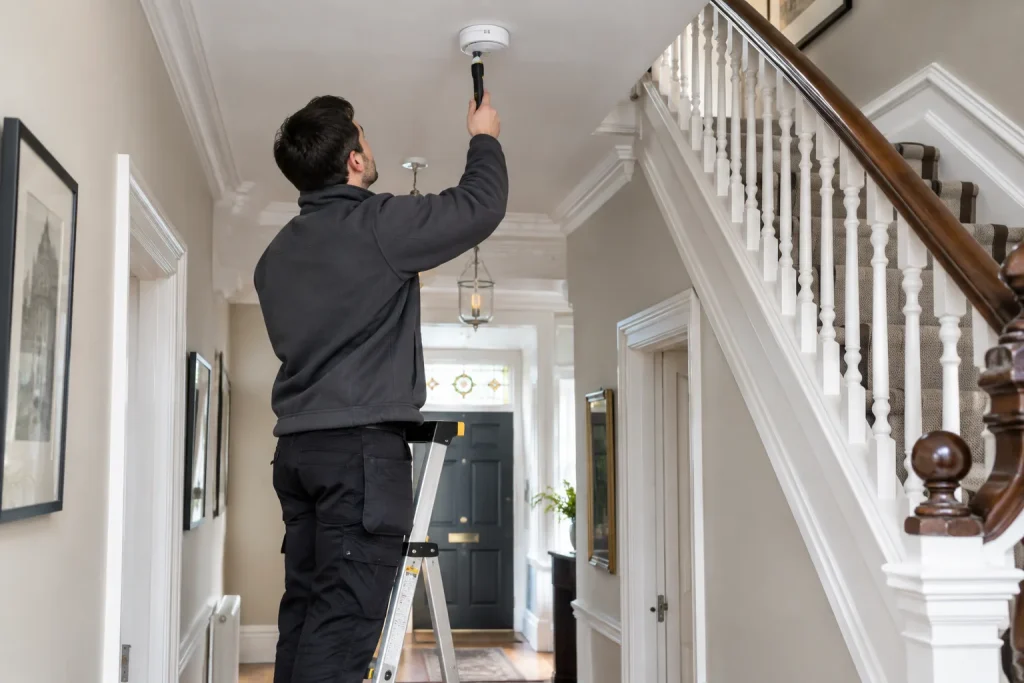
Searching for “smoke alarm certificate London”? You are not alone. Many London landlords and agents are told they must have a generic “smoke” or “fire alarm” certificate to start or renew a tenancy. For most standard private rentals, that is not what the law says. This guide separates legal duties from licensing conditions, shows when a formal certificate is genuinely required, and explains the simple evidence that will satisfy most compliance checks.
Do London landlords legally need a “Smoke Alarm Certificate”?
There is no blanket legal requirement for a “smoke alarm certificate” in every rented home in London. Your exact duty depends on the type of property and whether a local licence applies.
Standard private lets (single households) – what the law says
- Applies to: Most private rented homes that are not licensed HMOs and have no specific licensing condition about alarms.
- Legal duties: Provide a smoke alarm on each storey used as living accommodation and a carbon monoxide (CO) alarm in any room containing a fixed combustion appliance (for example, gas boiler, log burner or oil appliance). Gas cookers/hobs are excluded from the CO requirement under the current regulations.
- Day-one test: You must ensure alarms are in working order on the first day of a new tenancy and repair/replace them if tenants report faults.
- Certificates: The regulations do not require a generic “smoke alarm certificate” for these homes. Councils may ask for evidence of compliance (see “Evidence you should keep”).
- Enforcement: Councils can serve a remedial notice and issue a civil penalty of up to £5,000 per breach if you fail to comply.
HMOs and licensed properties – when certification is required
- Applies to: HMOs and any rented property that is subject to mandatory, additional or selective licensing with specific fire safety conditions.
- Typical expectations: A domestic fire detection and alarm system designed to BS 5839‑6 (often Grade D1/D2, Category LD2 in HMOs), with interlinked alarms and coverage in risk rooms such as escape routes, living rooms and kitchens. Some boroughs also require or expect emergency lighting in common areas.
- Certificates: Councils may request fire alarm design/installation/commissioning certificates, periodic service/maintenance reports and, where fitted, emergency lighting test certificates. For example, Newham notes fire alarm and emergency lighting test certificates can be requested during licence audits, and Westminster benchmarks BS 5839‑6 Grade D1 LD2 in certain rental standards. These are illustrations, not universal London-wide rules—always check your specific licence conditions.
| Scenario | What the law/licence expects | Certificate required? | Typical BS 5839‑6 benchmark |
|---|---|---|---|
| Standard private let (single household) | Smoke alarm on each storey; CO alarm in rooms with a fixed combustion appliance; test on day one; maintain when faults reported | No universal “smoke alarm certificate”. Keep clear evidence of compliance | ADB FAQ commonly references Grade D2 LD3 as a minimum for dwellings |
| Licensed HMO | Licence conditions typically require an interlinked domestic fire alarm system; periodic testing/servicing | Yes—design/commissioning/servicing documentation is usually requested | Often Grade D1/D2 LD2 (check your licence) |
| Blocks/common parts | Fire Safety Order applies in common areas; risk-based systems and maintenance | Yes—records and certificates for installed systems and emergency lighting | BS 5839‑1 (non-domestic) for common parts; BS 5839‑6 within flats |
What alarms are required and where?
- Smoke alarms: At least one on every storey used as living accommodation. For best practice, position on ceilings, ideally in circulation spaces (hallways/landings) and follow manufacturer instructions.
- Heat alarms: Recommended in kitchens to reduce false alarms; often required in HMOs as part of LD2 coverage.
- CO alarms: In each room containing a fixed combustion appliance such as a gas boiler, coal or wood-burning fire, or oil appliance. Gas cookers are excluded by the current regulations.
- Power type: Battery-powered alarms are acceptable under the regulations, but sealed-for-life (tamper-proof) batteries are recommended. Many HMO licences specify mains-powered, interlinked (Grade D1) devices.
- Interlinking: Not universally required in standard single-household lets, but commonly required in HMOs under licence conditions and recommended where risk justifies it.
Evidence you should keep if no formal certificate is mandated
If your property is not licensed (or your licence does not specify certification), keep a simple compliance file so you can prove you meet the regulations:
- Inventory entry confirming alarms present, tested and audible on the first day of the tenancy (tenant signature or digital acceptance).
- Photos/videos of each alarm in situ, with date-stamp.
- Device details (location plan, make/model, battery type, install date, and—if available—serial numbers).
- Tenant communications acknowledging day-one testing, plus any maintenance reports and your response record.
- Receipts/invoices for alarms purchased or installed.
- Maintenance log of tests or replacements during the tenancy.
When you do need a certificate or report
BS 5839‑6 systems – design, commissioning and servicing docs
- If you have an installed domestic fire detection and alarm system to BS 5839‑6 (e.g., in an HMO), you should hold the relevant design, installation and commissioning certificates, plus periodic service/maintenance reports in accordance with the British Standard.
- For common parts in blocks, systems are usually to BS 5839‑1, with test certificates and a logbook maintained.
Council licensing and audit requests
- Licensing conditions vary by borough. Typical HMO licences in London expect an interlinked alarm system (often Grade D1/D2 LD2) and may require you to produce test/maintenance certificates and logs on request.
- Illustrations (not universal rules): Newham states fire alarm and emergency lighting test certificates can be requested during audits; Westminster benchmarks BS 5839‑6 Grade D1 LD2 in rental standards. Always check your specific licence document.
Penalties, enforcement and access issues
- Remedial notices: If you fail to provide required alarms or ensure they work on the first day of a new tenancy, your council can serve a remedial notice. Non-compliance can attract a civil penalty up to £5,000 per breach.
- Reasonable steps and tenant access: If a tenant refuses access, take and document reasonable steps to comply—e.g., offer multiple appointments, send written notices, and keep correspondence and photographs. Councils can consider your evidence when deciding enforcement action.
- Repairs during a tenancy: You must repair or replace alarms promptly when tenants report faults.
Quick compliance checks before a tenancy starts
- Confirm a working smoke alarm on every storey used as living accommodation.
- Confirm CO alarms in all rooms with a fixed combustion appliance (boilers, solid fuel, oil). Remember: gas cookers/hobs are excluded by current regulations.
- Test all alarms on the first day of the new tenancy and record that test on the inventory.
- Check you have spare units or a plan for prompt replacement if a fault is reported.
- For HMOs/licensed properties, verify the system meets your licence (often interlinked Grade D1/D2 LD2) and that you hold current certificates and service records.
- Keep photos, model numbers and tenant acknowledgements in your compliance file.
What happens during a fire alarm inspection or service?
For properties with a BS 5839‑6 domestic system (common in HMOs), a competent engineer will typically:
- Review the system grade and category (e.g., Grade D1 LD2) against the property risk and any licence conditions.
- Carry out a visual inspection of detector locations, fixings and labelling.
- Functionally test manual call points (if fitted), sounders and detectors; confirm audibility and interlinking.
- Verify power supplies and any standby arrangements.
- Record findings in the logbook and issue a service/maintenance report noting any defects and recommended actions.
For standard private lets with standalone alarms, a pragmatic check includes location, test operation, expiry dates and suitability (e.g., sealed for life batteries), followed by a dated record in your inventory or property file.
How First Landlord Certificates London can help
- Install and test compliant smoke, heat and CO alarms across London homes.
- Upgrade systems to meet typical HMO licence expectations (e.g., interlinked LD2 layouts) where required.
- Document what’s been tested or installed so you can evidence compliance to agents and councils. [VERIFY CURRENT SERVICE DELIVERABLES]
- HMO and block support: Book BS 5839‑6 service/commissioning visits for HMOs and BS 5839‑1 maintenance for common parts, with clear reports for licensing or audits. [VERIFY CURRENT SERVICE DELIVERABLES]
If you’ve been told you “must have a fire/smoke alarm certificate” and you’re not sure whether that applies to your property, we’ll review your scenario and advise the simplest compliant route.
Ready to proceed? Book smoke/CO alarm install, test and (where applicable) certification or call 07424 498988.
FAQs
Is a smoke alarm certificate needed to start any tenancy in London?
No. For most single-household private lets, the law requires smoke alarms on each storey, CO alarms in rooms with a fixed combustion appliance, and testing on day one. There is no blanket requirement for a generic certificate—just be able to show evidence that you comply.
Are battery-powered alarms acceptable, and should they be sealed-for-life?
Yes, battery alarms comply with the regulations for standard private lets. Sealed-for-life (tamper-proof) models are recommended to reduce tampering and missed battery changes. HMO licences often specify mains-powered, interlinked alarms.
Where must CO alarms be fitted if there’s a gas boiler? Are gas cookers included?
Fit a CO alarm in every room with a fixed combustion appliance, including rooms with gas boilers. Gas cookers/hobs are excluded by the current regulations.
Do I need interlinked alarms (LD2) in a standard let vs an HMO?
Standard single-household lets are not universally required to have interlinked alarms. HMOs commonly require interlinked LD2 coverage under licence conditions. Check your licence.
What proof should I have if the council asks?
For standard lets, keep inventory sign-off showing day-one tests, photos with dates, device details and maintenance records. For HMOs/licensed properties, keep your BS 5839‑6 certificates, service reports and logbook entries (and emergency lighting certificates if applicable).
What if tenants refuse access to install or repair alarms?
Record your reasonable steps: appointment offers, notices, emails/texts, and any third-party attempts to arrange access. This evidence can be considered by councils when assessing enforcement.
Sources and further reading
- DLUHC: Smoke and Carbon Monoxide Alarm Regulations – Guidance
- London Fire Brigade: Fire alarms – property management
- GOV.UK: Approved Document B – Fire Safety FAQ (BS 5839‑6 reference)
- Newham Council: Licensing audit guidance (illustrative)
- Westminster City Council: Standards for rental accommodation (illustrative)
If you need help deciding whether your property needs formal certification or just clear evidence of compliance, contact First Landlord Certificates London.