
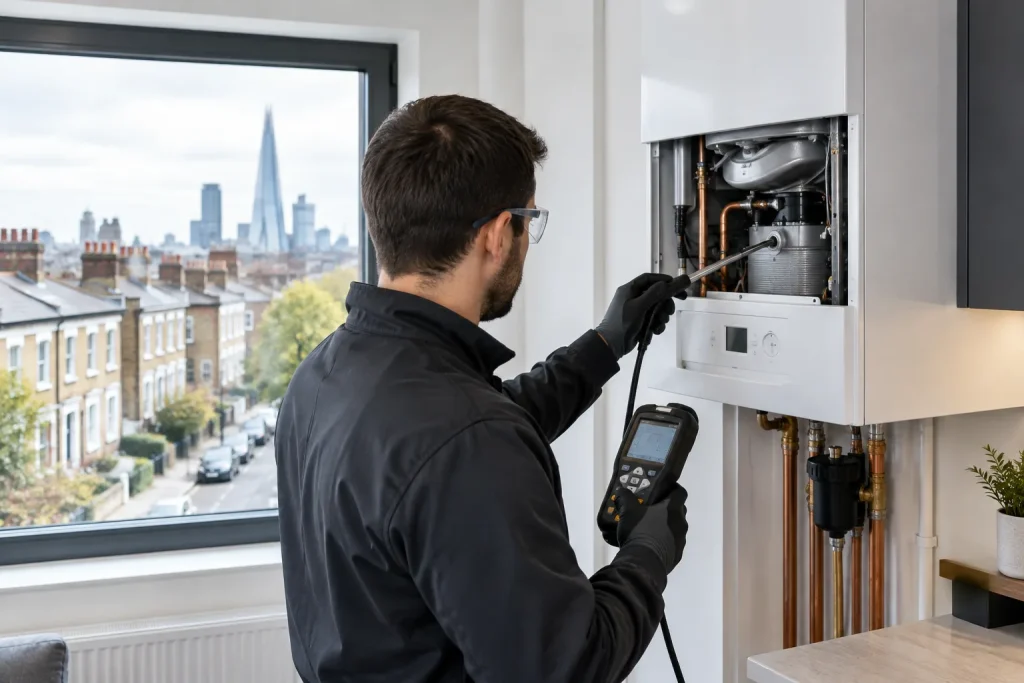
If you are a London landlord or managing agent, a CP12 is the commonly used name for the Landlord Gas Safety Record produced after an annual gas safety check. This guide explains what the check covers, what information the record must contain, when it must be given to tenants, the early-renewal flexibility, and how to prepare for an appointment.
Need to arrange a check? View FLCL’s Gas Safety Certificate service or call 07424 498988 to discuss an appointment.
What a CP12 Gas Safety Check Covers in a London Rental
A CP12 (also called a Landlord Gas Safety Record) confirms that each landlord-supplied gas appliance and associated flue in the property has been checked for safety in line with the Gas Safety (Installation and Use) Regulations 1998 (GSIUR). The check focuses on safety, not performance tuning or deep maintenance.
Landlord-supplied and tenant-owned appliances
- Landlord-supplied appliances: Gas appliances and flues that the landlord owns and provides for the tenant’s use must be included in the annual gas safety arrangements.
- Tenant-owned appliances: A landlord is not responsible for carrying out the gas safety check on a tenant’s own appliance. Where a flue serves only the tenant’s appliance, the tenant is responsible for that appliance and flue; however, HSE recommends that landlords consider including connected flues within gas safety arrangements as good practice.
- Installation pipework: Installation pipework is not itself part of the annual gas safety check, but landlords must keep it in a safe condition. HSE recommends asking the Gas Safe registered engineer to visually examine the pipework and test the gas system for soundness when appropriate.
Typical checks and what the engineer records
A Gas Safe–registered engineer will carry out a set of safety checks and record the results. Expect some or all of the following, depending on the appliance type and installation:
- Appliance identification and location: Confirm make/model and where each appliance is installed.
- Visual condition: Check for correct installation, secure mounting, accessible isolation and emergency control valves, signs of damage, scorching or staining, and correct operation of flame supervision devices.
- Ventilation: Ensure the room has adequate permanent ventilation if required by the appliance type.
- Flueing and chimney check: Confirm the flue is continuous and correctly terminated; carry out flue flow and spillage checks where appropriate; visually check accessible flue routes and terminals.
- Combustion and CO risk: For modern boilers with test points, perform combustion analysis; assess carbon monoxide (CO) risk indicators and advise on CO alarm best practice.
- Operating pressure and gas rate: Measure appliance operating pressure and/or burner pressure and gas rate against manufacturer data where appropriate.
- Safety devices: Test that safety controls operate correctly (e.g., flame failure devices).
- Installation pipework tightness test: Where practicable, perform a tightness test at the meter/emergency control valve to check for leaks on the installation. Any detected leak is classified and actioned in line with Gas Industry Unsafe Situations Procedure.
- Defects and actions: Identify and classify any defects (e.g., Immediately Dangerous, At Risk), make safe, and record any remedial advice or actions taken.
| Item checked | What the engineer does | What appears on the record |
|---|---|---|
| Appliances (boiler, cooker, fire) | Visual, ventilation, safety device tests, combustion checks as applicable | Description/location, test results, pass/fail notes, defects and actions |
| Flues/chimneys | Flue flow/spillage tests, terminal check, accessible route inspection | Flue condition/results, any advisories |
| Operating pressure/gas rate | Measure and compare to manufacturer data | Measured values and compliance confirmation |
| Installation pipework (best practice) | Tightness test at meter where practicable | Test performed Y/N and any leak/defect notes |
Annual Renewal and the Two-Month Early-Check Flexibility
Landlords must arrange an annual gas safety check for the relevant gas appliances and flues. Under the Gas Safety (Installation and Use) (Amendment) Regulations 2018, the next annual check may be carried out up to two months before the date it is due while retaining the original annual deadline, as though the check had been completed exactly 12 months after the previous deadline.
This flexibility can help landlords arrange access and appointments in advance without unnecessarily bringing the annual deadline forward. Where the early-check flexibility is used, keep sufficient previous records to demonstrate that the required timescales were followed.
Gas Safety Records and Tenant Copies
After the gas safety check, the landlord must receive a gas safety check record. The document is often still referred to as a CP12 or Landlord Gas Safety Record.
What the gas safety check record must contain
- A description and location of each appliance or flue checked.
- The name, Gas Safe registration number and signature of the individual who carried out the check.
- The date on which the appliance or flue was checked.
- The address of the property.
- The name and address of the landlord or their agent, where appropriate.
- Any safety-related defect identified and any remedial action taken.
- Confirmation that the required safety matters under the Gas Safety (Installation and Use) Regulations were examined.
Electronic records and retention
Gas safety records may be stored electronically if they are secure and can be reproduced in hard-copy form when required. A tenant may receive the record electronically where they are happy to receive it that way and can access it; a paper copy must be provided if requested.
Records must normally be kept for at least two years. If the early-check flexibility is used to retain the original annual deadline, HSE advises keeping the relevant records long enough to demonstrate compliance with those timing rules, including until two further gas safety checks have been carried out where applicable.
When tenants must receive the record
- Existing tenants: Give them a copy within 28 days of the gas safety check being completed.
- New tenants: Give them a current copy before they move into the property.
- Evidence: Keep a sensible record of when and how the document was provided, particularly where it was sent electronically.
CP12 vs Boiler Service — What’s the Difference?
A gas safety check and a boiler service are different activities.
- Annual gas safety check: Checks the relevant landlord-supplied gas appliances and flues for safety and produces the gas safety check record.
- Boiler service: Maintenance of the appliance in line with the manufacturer’s instructions and the engineer’s assessment. Servicing can include additional inspection, cleaning and maintenance work that is not automatically part of the landlord gas safety record.
Do not assume a boiler service is included with a gas safety check. If servicing is required, confirm separately what work has been booked.
Access, No‑Access and HMOs
Reasonable notice and what to do if you can’t gain access
- Give reasonable notice: Write to tenants with proposed dates/times, explaining the legal requirement and their cooperation duty under the tenancy.
- Keep records: Save copies of letters/emails/SMS, attempted calls, and any calling cards left at the property.
- Do not force entry: For safety and legal reasons, you should not force access. If access is refused, continue to take reasonable steps to rearrange and document everything. Your evidence may be important if queried by the regulator or in tenancy disputes.
- Reschedule promptly: If you approach the 12‑month deadline and still cannot gain access, continue to show persistent, reasonable attempts and complete the check as soon as access is granted.
HMOs and property-licensing conditions
If the property is licensed as an HMO or under another local licensing scheme, check the exact conditions attached to that licence. Local-authority requirements can vary, and a council may require current gas safety documentation to be produced on request or as part of the licence conditions. Do not assume every London borough uses identical conditions.
How to Prepare (Checklist)
Good preparation helps the engineer complete the CP12 efficiently and reduces the risk of advisories or no‑access charges.
- Appliance list: Confirm which gas appliances are landlord‑supplied (boiler, hob/cooker, fires) and note any tenant‑owned appliances.
- Clear access: Clear space around the boiler, gas fire, and hob; ensure the engineer can easily access the gas meter and any flue inspection points.
- Power and gas available: Ensure the property has power, water and gas. If there is a prepayment meter, top it up beforehand.
- Keys and entry: Arrange keys and any concierge permissions. Provide full address details, floor or flat number, and entry instructions.
- Parking info: Share parking or loading details to help the engineer reach you without delay.
- Pets and children: Secure pets and ensure an adult is present if required by the tenancy.
- CO and smoke alarms: Gas safety checks do not replace separate alarm duties. In England, relevant landlords must ensure at least one smoke alarm is provided on each storey containing living accommodation and a carbon monoxide alarm is provided in any room used as living accommodation that contains a fixed combustion appliance, except a gas cooker. Follow the current alarm guidance and manufacturer instructions.
- Boiler manual and service history: If available, leave the boiler manual and any service log for the engineer.
Book a CP12 in London
FLCL provides a Gas Safety Certificate booking service for London landlords and property managers. View the Gas Safety Certificate service and book online or call 07424 498988 to discuss an appointment. Gas safety checks themselves must be carried out by an appropriately Gas Safe registered engineer.
FAQs
Is a CP12 the same as a Landlord Gas Safety Record?
Yes. “CP12” is the industry’s legacy term; today’s document is formally called the Landlord Gas Safety Record. Many people still use CP12 to mean the same thing.
How long does a CP12 last and when should I renew?
A CP12 covers you for 12 months from the date of the last safety check. Use the ‘MOT‑style’ window by completing the next check between 10 and 12 months after the previous one to preserve your annual deadline date for the following year.
Do I need a CP12 if the tenant owns the gas cooker?
You do not need to safety‑check or service a tenant’s own cooker, but you do remain responsible for the installation pipework and any flue that serves it. It’s sensible to confirm with the tenant what they own and ensure your engineer can check the installation safely.
Can I email the record to my tenant, and how long must I keep it?
Yes, you can email the record if the tenant agrees and can access it; otherwise provide a paper copy. Keep each record for at least two years (longer is prudent for tenancy evidence).
What if I missed the annual gas safety deadline?
Arrange the gas safety check as soon as possible. If access has been a problem, keep evidence of the reasonable steps taken to arrange the check and continue trying to obtain access without forcing entry. For case-specific enforcement or tenancy consequences, obtain appropriate legal advice.
Does a CP12 include a boiler service?
Not automatically. The annual landlord gas safety check and appliance servicing are separate requirements. If you also want a boiler service, confirm separately that servicing has been included in the work booked.
Related safety certificates for landlords
- Electrical Installation Condition Report (EICR)
- Energy Performance Certificate (EPC)
- Fire Alarm Certificate
- Emergency Lighting Certificate
Ready to proceed? Book your CP12 online or call 07424 498988 for help scheduling your inspection.